
Tesla (TSLA) is one of the most recognizable companies in the world. Known for its electric vehicles, battery technology, autonomous driving initiatives, and renewable energy solutions, Tesla has attracted millions of investors globally.
For Muslim investors, however, popularity alone is not enough. Before investing in any stock, it is important to determine whether the company meets Islamic investment principles and Sharia compliance standards.
So, is Tesla stock halal?
What Does Tesla Do?
Tesla designs and manufactures electric vehicles, energy storage systems, solar energy products, and related technologies. Its primary sources of revenue come from:
-
Electric vehicle sales
-
Automotive services
-
Energy generation and storage products
-
Software and technology services
Unlike traditional automakers that rely heavily on financing and interest-based operations, Tesla's core business revolves around manufacturing and selling products, which is generally considered permissible under Islamic principles.
Step 1: Business Activity Screening
The first step in determining whether a stock is halal is evaluating the company's primary business activities.
Tesla does not generate revenue from:
-
Conventional banking
-
Insurance
-
Gambling
-
Alcohol
-
Tobacco
-
Adult entertainment
-
Weapons manufacturing
-
Other prohibited industries
Its primary business consists of manufacturing electric vehicles and energy products, which are permissible business activities.
Result: Tesla passes the business activity screen.
Step 2: Debt Ratio Screening
Most Sharia standards place limits on how much interest-bearing debt a company can carry.
Tesla's reported debt includes:
-
Short-Term Borrowings: $1.37 billion
-
Long-Term Borrowings: $7.64 billion
-
Total Borrowed Capital: $9.02 billion
Tesla's market capitalization is approximately:
-
Market Cap: $1.50 trillion
Debt Ratio Calculation:
Debt Ratio = Total Debt ÷ Market Capitalization
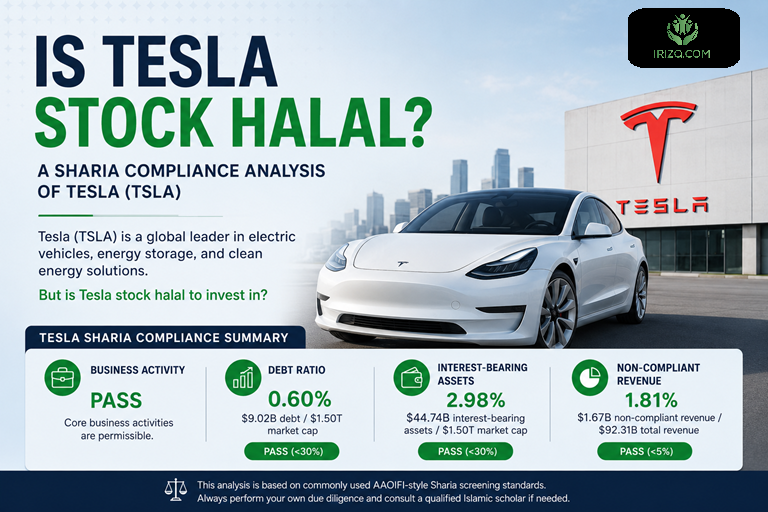
$9.02B ÷ $1.50T = 0.60%
Most Sharia screening methodologies allow up to 30%.
Result: Tesla easily passes the debt ratio screen.
Step 3: Interest-Bearing Assets Screening
Islamic scholars also evaluate how much of a company's assets are held in interest-bearing accounts and fixed-income securities.
Tesla currently holds:
-
Cash & Cash Equivalents: $16.60 billion
-
Marketable Debt Securities: $28.14 billion
-
Total Interest-Earning Assets: $44.74 billion
Asset Ratio Calculation:
$44.74B ÷ $1.50T = 2.98%
This remains well below the commonly used 30% threshold.
Result: Tesla passes the interest-bearing assets screen.
Step 4: Non-Compliant Revenue Screening
Companies may earn a portion of their income from interest or other non-permissible sources. These amounts must remain below acceptable thresholds.
Tesla reported:
-
Traditional Interest Income: $1.67 billion
-
Total Revenue: $92.31 billion
Non-Compliant Revenue Ratio:
$1.67B ÷ $92.31B = 1.81%
Most Sharia screening standards allow up to 5% non-compliant revenue.
Result: Tesla passes the non-compliant revenue screen.
Tesla Sharia Compliance Summary
| Screening Category | Result |
|---|---|
| Business Activity | Pass |
| Debt Ratio | Pass |
| Interest-Bearing Assets | Pass |
| Non-Compliant Revenue | Pass |
Based on commonly used AAOIFI-style Sharia screening standards, Tesla appears to satisfy the requirements for a halal stock.
The Elon Musk Factor: Why Some Muslims Still Avoid Tesla
While Tesla may pass the financial and business activity screens, some Muslim investors choose not to invest in Tesla for reasons beyond traditional Sharia compliance metrics.
Tesla's CEO, Elon Musk, has made various public comments and political statements over the years that some Muslims view as hostile toward Muslim communities or aligned with policies they disagree with. As a result, some investors feel uncomfortable supporting companies closely associated with him.
This introduces an important distinction:
Sharia Compliance vs. Personal Ethical Preference
A stock can be:
-
Sharia compliant from a financial and business perspective
-
Yet still avoided by individual investors for personal ethical, political, or social reasons
Many Muslim investors today are increasingly applying additional filters beyond standard Sharia screening. They may consider:
-
Corporate leadership behavior
-
Political activism
-
Social impact
-
Environmental concerns
-
Alignment with personal values
For these investors, Tesla's compliance status is only one part of the decision-making process.
Should Muslims Invest in Tesla?
From a pure Sharia screening perspective, Tesla appears to qualify as a halal stock because:
-
Its core business activities are permissible.
-
Debt levels are extremely low relative to its market value.
-
Interest-bearing assets remain within accepted thresholds.
-
Non-compliant revenue is well below commonly accepted limits.
However, investing decisions ultimately involve more than just screening ratios. Every Muslim investor must determine whether they are comfortable owning a company based on both Islamic guidelines and their personal values.
Final Verdict: Is Tesla Stock Halal?
Yes. Based on commonly accepted AAOIFI-style Sharia screening standards, Tesla (TSLA) appears to be Sharia compliant and generally considered halal to invest in.
That said, some Muslim investors continue to avoid Tesla because of concerns surrounding Elon Musk's public statements and views. While these concerns do not affect Tesla's financial Sharia compliance status, they may influence individual investment decisions.
As always, investors should conduct their own due diligence and consult a qualified Islamic scholar if they have questions about their specific situation.
Want to check whether a stock is halal?
Use the iRizq Halal Stock Checker to instantly screen stocks using Sharia compliance standards and see detailed debt, revenue, and purification calculations before investing.